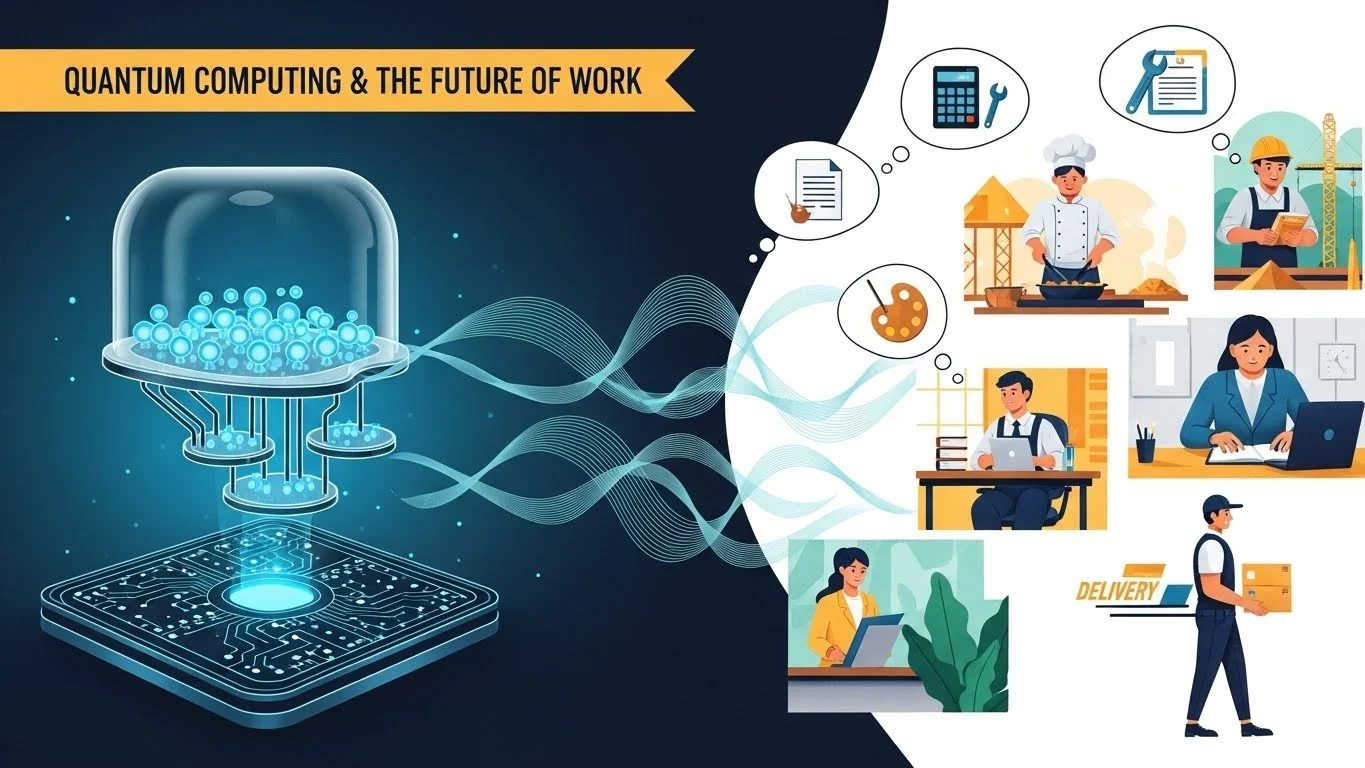
Imagine your laptop struggling to crack a tough puzzle. It takes hours, maybe days. Now picture a machine that solves it in seconds by trying every path at once. That’s quantum computing in a nutshell. Unlike regular computers that use bits—simple 0s or 1s—quantum ones rely on qubits. These qubits can exist in multiple states thanks to superposition, like a coin spinning in the air showing heads and tails together. Entanglement links qubits so one change affects another instantly, no matter the distance. This power isn’t just sci-fi; it’s set to reshape jobs you do every day.
This article breaks down what quantum computers mean for everyday jobs. We’ll skip the physics overload and focus on real changes in work roles. From finance pros to lab techs, see how your career might shift—and how to get ready.
Understanding the Quantum Leap Beyond Bits and Bytes
Qubits vs. Bits: The Fundamental Difference in Processing
Bits in your phone or PC flip between zero and one. Qubits dance in a mix of states. This lets quantum computers handle vast options side by side. Think of it like searching a huge library: a regular computer checks books one by one, but a quantum one scans them all at once.
This setup shines in tricky tasks. Optimization problems, like finding the best route for deliveries, get a huge speed boost. Simulations of chemicals or weather also run faster. No more waiting weeks for results that guide big decisions at work.
Current State of Quantum Hardware and Accessibility
Big names like IBM, Google, and IonQ lead the pack. In 2026, their machines have improved, but errors still pop up. We’re in the NISQ phase—Noisy Intermediate-Scale Quantum—good for tests, not perfection.
Businesses tap in via the cloud. Quantum-as-a-Service lets firms rent time on these systems without buying hardware. Startups in drug design already use it. Your company might soon follow for quick wins in data crunching.
Identifying “Quantum-Resistant” vs. “Quantum-Enhanced” Jobs
Some jobs stay safe from big shakes. Teaching or nursing rely on human touch; quantum won’t replace that soon. Others get a boost, like analysts using quantum tools for sharper insights.
Displacement hits roles tied to slow computations. Think manual risk checks in banks. Augmentation helps coders build better apps with quantum speed. The key? Spot if your work solves complex puzzles. If yes, expect change.
Revolutionizing Finance and Data Analysis Jobs

Portfolio Optimization and Algorithmic Trading
Finance folks juggle risks and returns daily. Classical computers grind through scenarios in Monte Carlo runs, but they take too long for live trades. Quantum setups cut that time to minutes. Traders spot winning strategies faster, beating market swings.
Look at JPMorgan’s work with IBM. They test quantum for portfolio tweaks. Results show 10-20% better returns in simulations. If you handle investments, this means tools that predict dips with eerie accuracy. Your job evolves from guesswork to guiding smart machines.
Advanced Fraud Detection and Cybersecurity Vulnerabilities
Spotting fraud in bank data feels like hunting needles in haystacks. Quantum computers sift patterns in seconds, flagging odd transactions across millions. Banks save billions yearly this way. Your role as a fraud analyst shifts to verifying quantum alerts.
But there’s a catch. Shor’s algorithm breaks old encryption like RSA. Hackers with quantum gear could crack secure logs. Firms must switch to post-quantum crypto now. Start auditing your systems; delay costs jobs and trust.
Quantum Machine Learning (QML) in Market Forecasting
Market predictions rely on data mountains. Classical machine learning chugs along, missing subtle links. QML handles high-dimensional sets with ease. It forecasts stock trends or economic shifts better than before.
Economists at places like Goldman Sachs experiment with it. One study showed QML cutting forecast errors by 15%. If you crunch numbers for reports, learn QML basics. It turns your spreadsheets into super predictors.
Transforming Science, Engineering, and R&D Roles
Drug Discovery and Materials Science Simulation
Developing new drugs means modeling molecules. Classical sims hit walls with complex bonds; they explode in compute needs. Quantum computers mimic nature at the atom level. This speeds up finding cures or better batteries.
Google’s team simulated a simple molecule in hours, not years. Pharma giants like Merck partner for this. Lab techs and chemists gain tools to test ideas fast. Your R&D job? Less trial-and-error, more breakthroughs.
- Key benefits:
- Faster drug trials save lives.
- New materials boost clean energy.
- Teams focus on ethics over endless runs.
Optimizing Logistics and Supply Chain Management
Supply chains tangle like urban traffic. The traveling salesperson puzzle—best route for trucks—grows impossible with scale. Quantum annealing from D-Wave solves it for global nets. Routes shorten, costs drop.
Planners at UPS test these now. One trial cut fuel use by 12%. If you manage warehouses or fleets, expect software that auto-optimizes. Analysts interpret outputs, keeping humans in the loop.
Climate Modeling and Complex System Analysis
Climate models need fine details on winds and oceans. Regular computers simplify too much, leading to fuzzy forecasts. Quantum power adds layers for accurate sims. This helps design wind farms or predict floods.
NASA uses quantum for turbulence flows. A recent paper showed models 30% more precise. Engineers in green tech get better data. Your role in analysis? Turn raw sims into policy wins.
Impact on Creative, Administrative, and Entry-Level Roles
Automation and Increased Efficiency in Administrative Tasks
Admin work like filing reports seems far from quantum. But backend wins, like quick supply routing, free up time. Workflows speed up; you handle more with less hassle.
No big job loss here. Instead, upskill in tools that use quantum outputs. Data entry clerks might verify enhanced reports. Efficiency means promotions, not pink slips.
Redefining Software Development and Programming Paradigms
Coders build apps on classical logic. Quantum demands new tricks, like Qiskit from IBM. You write code for qubits, not bits. Bugs differ; debugging feels like quantum puzzles.
Start with free Qiskit tutorials online. Developers fluent in both worlds lead teams. Your entry-level gig? Evolve to quantum debugging, a hot skill by 2030.
The Evolving Need for Human Oversight and Interpretation
Quantum spits out answers to wild questions. But who asks the right ones? You do. Interpret results with real-world smarts; ethics matter too.
In creative fields, like design, quantum optimizes layouts. Artists oversee the human spark. Entry roles gain from this—more time for growth.
Preparing Your Career for the Quantum Era
Essential New Skills for Quantum Readiness
Build basics like linear algebra; it’s key for qubit math. Grasp complexity theory to know what quantum excels at. Hone information skills to make sense of outputs.
Free courses abound. IBM’s Quantum Learning on Coursera starts easy. Google’s Quantum AI cert fits busy schedules. Pick one; practice weekly.
- Top skills:
- Qubit basics.
- Algorithm tweaks.
- Ethical framing.
The Rise of the Quantum Integrator Role
New jobs blend quantum know-how with your field. A quantum financial modeler mixes code and market sense. You bridge tech and tasks.
These roles pay well—salaries hit $150K in tests. Demand grows as firms adopt. Train now to claim one.
Navigating the Timeline: Near-Term vs. Long-Term Impact
Early hits come in niches like finance sims; see changes in 2-5 years. Full fault-tolerant quantum? 10-15 years out for most jobs.
Specialists feel it now via cloud tools. Average workers adapt gradually. Stay alert; small steps build big edges.
Conclusion: Embracing Quantum Literacy as a Core Competency
Quantum computers reshape how we tackle tough work, not erase jobs outright. Finance sees real-time trades; science gets faster discoveries. Even admin roles gain from efficiency ripples.
The big takeaway? Learn a bit about quantum now. It turns fear into opportunity. Adapt, and you’ll thrive as this tech rolls in. Start a course today—what’s your first step?
